
Daily Rhythm
8:00am - Center opens, drop-offs begin, children have unstructured time until a.m. snack
9:15am - Morning snack begins
Bathroom routine
10:00am – Circle time and structured learning
Monitor for bathroom needs
10:15am-11:30am– Outdoor period, structured and unstructured learning
11:45am – Lunch begins
Bathroom routine
12:15pm-2:15pm – Rest period begins
Bathroom routine
2:30pm – Afternoon snack begins
3:15pm-5:00pm – Outdoor period until parent/caregiver pick up (monitor for bathroom needs)
Sprouts
✺ Our Toddler Classroom Priorities ✺
-
Circle time with the toddlers consists of a good morning song that shows love to each child one by one, checking the weather with our weather gnomes, practicing our phonetics, reading/telling a short story, and singing interactive songs that teach concrete concepts.
-
Learning the alphabet is integral for early literary success. It is our belief that children who learn the phonetic sounds, out of order, will have better success as an early reader. Why? Because words are letters out of order, read successfully, by combining the phonetic sounds of each letter.
-
Music is a staple in our toddler rooms, you will always hear music playing, or educators singing - often both synchronously, and not always in English. Music teaches rhythm, introduces new languages, improves mood and self-regulation, and provides an abundance of auditory discrimination; to name just a few. Musical instruments are always present in our learning spaces, children sometimes just need to bang/shake a tambourine, shake up a maraca, or bang a drum until their heart is full.
-
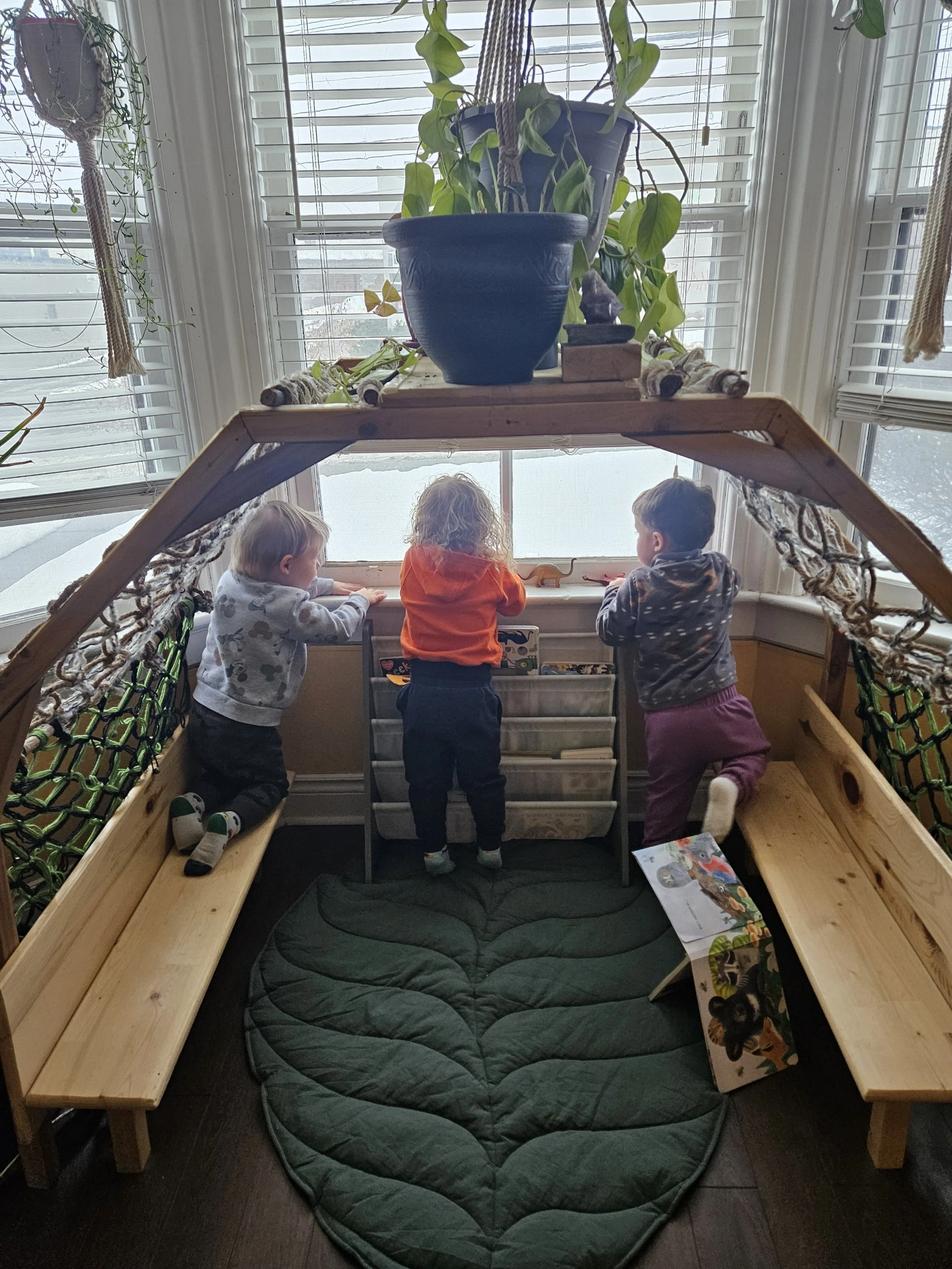
Everything in our space is child-sized and designed for the children to explore their fine and gross motor milieu. There are chairs of various child sized heights that they can practice sitting and balancing with. Indoor climbers they can climb, open spaces they can practice walking, skipping, hopping, dancing, and even running in. Having a plethora of learning materials that challenge the children use their fine motor skills, whether it’s self-selecting pencil crayons to draw, carrying objects from one place to the next, or practicing wiggling their toes when we play “this little piggy”.
-
Outdoors are integral to our programming. It provides the children an indefinite amount of teachable moments. The outdoors are rich in nature experiences, from bugs, mud, dirt, birds, butterflies, greenery, and more. To our sustainable play materials, like tree stumps, wooden play structures, and child sized benches and chairs for the children to rest on. Community walks are also a program highlight, what better way to learn about the world around you, than to get out there and explore your surroundings!
-
We believe toddlers are intelligent, competent, capable, human beings. We empower the children to assert their needs, and then we respect them by meeting that need. We allow them the space, time, and patience to practice dressing and undressing for outdoor time, putting their shoes and boots on and off, and so on. We empower them to blow their noses by leaving facial tissue within their reach. Children who believe they can, will!
-
The neural pathways in a child’s brain reduce by half by early childhood. The more sensorial stimulus they receive the more synaptic connections remain intact. It is the nature of brain development that neural pathways that do not serve as a necessary function are pruned away make room for the synaptic connections that are deemed necessary. We meet this need by providing the children a sensory room they can access freely.
-
Plants are essential to life on Earth, many being used for food, and medicine. The toddlers might not understand these deeper concepts, but it does not deter us from educating them about a plants function, how to care for plants, how to grow plants, and become familiar with the basics: seed, germinate, sprout, bud, flower.
-
Color theory is represented both directly and indirectly in program. When a toddler holds up or points to an object an educator will say “purple ball” for example. Pencil crayons and paper are within reach for them to explore color at their whim, and painting is done weekly. We always start with the primary colors, move into secondary colors, and then let the children explore to their hearts content with color blending.
-
Math is taught to the children both directly and indirectly. We provide materials that help them pattern, stack, group, as well as adding and subtracting. Our educators reresnt numbers through book, song, and impromptu teachable moments. Our toddlers also practice their maths through baking - we are the bread making connoisseurs of Nature’s Nest!
-
Science is all around us. It’s in every concept we teach - color, botany, math, music, art & so much more. When we make the bread, when we color mix, when we create child-safe chemical reactions, and when we explore cause & effect. Cause & effect being the most prominent science concept we teach directly, and daily.
-
Every child is born artist; their brains are so open to creativity that they must always have materials available to them that will feed that need. Toddlers have an insatiable need to scribble, it comes from a combination of vision and movement. Along with having constant access to colored pencils, the toddlers also have a chalkboard at their level they can use freely. Scribbling is not just a pleasurable experience for children, it also sets the foundation for them to begin writing letters and words.
-
Having manners, and a respect for their learning space is a key value we work toward instilling in our toddlers. They are expected to put things back where they found them when they are done, they are expected to clean-up their dishware after each meal, scraping leftovers into the bin, dirty dishes into their bin, putting their water bottles away, and even tucking their chairs in when they are done with them. We teach them to put things away gently, close doors with care, and learn the difference between indoor voices and outdoor voices.
-
In our toddler programs we refer to the children as friends to one another. We believe that by setting the standard that we all start as friends, it becomes more understandable to teach a toddler what others like and don’t like in friendship, and we can teach them how to assert social boundaries in friendship. Pro-social behavior is the expectation, empowering the toddlers to make pro-social choices on their own is the goal.
A day in the life of a Sprout
-
✺
Orientation
Children building their orientation schema are interested in how objects look from different angles and perspectives. These are the children you notice hanging upside down in the playground or bending over to see things through their legs, they are developing their orientation schema. Sometimes you might even notice them turning objects over to look at them from a new angle.
These children enjoy experimenting with magnifying glasses, mirrors, and reflections and can even show an interest in balancing objects or exploring height and weight. These children are in their element when we provide them with every opportunity to view the world and their materials from every angle and perspective possible.
-
✺
Transporting
Do you ever notice how children love to carry objects from one place to another or move them around the classroom? No doubt they are building their transporting schema.
These children are learning about where things belong. They are often building concepts of distance and mapping out their environment too. We aim to provide these little learners with containers – buckets, baskets, bowls, bags, and lots of loose parts like blocks, counters, stones, and even water.
Always keeping their materials on the same shelf, gives the children the ability to move things wherever they like, while also setting a boundary about where they belong when they are done moving their materials around the classroom.
-
✺
Trajectory
Children building the trajectory schema will love experimenting with direction, force and motion, and cause and effect. Our students who are always throwing objects and watching them as they land, are certainly developing their trajectory schema.
Exploring movement and Science units on How Things Move will always grab the attention of children developing their trajectory schema. This schema is all about movement.
Developmentally, this schema is supposed to be one of the earliest schemas that young children explore but in our experience, many children are still developing this schema in preschool and kindergarten. These children benefit from activities involving toy cars, paper planes, spinning objects, marble runs, and anything to do with balls.
-
✺
Positioning
Children building their positioning schema are often lining objects up or placing them in some type of careful alignment. The positioning of objects will involve stacking and won’t always be about aligning objects alongside each other either.
These children are learning all about classification, order, sequences, shape, symmetry, and creating patterns. Repeating patterns are of great interest to children developing this schema too. So many math concepts rely on a student’s understanding of the positioning schema.
-
✺
Enveloping
An enveloping schema is an interest in wrapping up objects or themselves. As children explore the enveloping schema we notice them completely wrapping up objects or covering whole pieces of paper in one colour. This is also when children like to create cubbies or “hidey holes” to hide in too.
When children are developing the enveloping schema, they are building measurement concepts around shape, space, and volume. Box construction and makerspaces are popular investigation areas for children exploring this schema.
-
✺
Rotation
Related to the trajectory schema is the rotation schema. This schema is all about objects that turn, spin, or rotate. Primarily this schema involves a child’s own bodies, balance, and coordination.
In early education, you will always notice children exploring anything that rotates – including their own bodies as well as objects. That child turning the taps on and off? …Yes!! They are exploring the rotation schema.
By using salad spinners, wheels, hoops, water wheels, windmills and even winding wool around objects for engaging activities we aim to help these children to build their rotation schemas.
-
✺
Transforming
Children working within the transformation schema are interested in change. They will be keen to explore any objects changing in appearance or substance. Sometimes these children might be interested in lifecycles and how living things transform or change into something new.
Children building their transformation schema are building an understanding of cause and effect. Sensory play, play dough, and mixing paint or mud kitchen ingredients are highly engaging activities for these students. Most of the science experiments we do, especially in Chemistry, are perfect for children developing the transformation schema.
-
✺
Enclosing
This schema is often observed in block play and in dramatic play. Children building their enclosure schema are always creating boundaries and borders to contain objects or themselves.
These are the children we notice building enclosures like fences and walls with the blocks and other small world play objects. They love to wrap up dolls and toys in the dramatic play space. Sometimes you might even notice them enclosing their own bodies by wrapping themselves up in fabrics or hiding in small spaces.
-
✺
Connecting
Children building their connection schema are learning how things connect and separate. They would be exploring concepts of size and shape and the forces of pushing and pulling too. You will notice these children are fascinated with construction sets like Lego®. They will enjoy joining things together, tying things up, and dismantling objects as well.
These children will be drawn to tinkering, they are also interested in the arts and collage space where they can glue and stick things together. Children developing their connecting schema will work for extended periods of time connecting and disconnecting objects or joining and separating things.