
Saplings
Full-day Daily Rhythm
8:00am to 9:30am - Drop offs and free play
9:45am - Morning snack
10am - Morning structured lesson
Bathroom routine
10:30am - Outdoor recreational learning OR community outing
Bathroom routine
12:00pm - Lunch
1pm to 2pm - Quiet structured activity time
Bathroom routine
2:15pm - PM snack
2:45pm - Afternoon structured lesson
Bathroom routine
3:30pm to 5:00pm - Outdoor free until parent pick-ups
✺ Our JK-Grade 1 Classroom Priorities ✺
-
In Preschool we use circle time to help children extend their attention spans, we encourage our educators to make circle time as interesting to the child as possible to ensure the children are engaged and excited to learn. In Preschool children have a deeper understanding of what circle time means and how it looks in our program settings. Circle time is a great opportunity to introduce complex concepts as the children give the educators their undivided attention. During circle time the children are able to have autonomy surrounding the songs we choose to sing, the books we get to read and the educators take the suggestions the children give and make it a reality.
-
In our Preschool program we have a plethora of activities and books readily available for the children at all times. We do this to ensure the children are exposed to early literacy at all times, allowing them to pave their own path to reading. The more time we spend with books, the more likely the children are able to start to retain and understand the concepts being taught, especially when we oblige them and read their favorite book for the twelfth time that day. Another way we encourage reading comprehension is when our educators introduce a book, importance is given to stop and engage the children about what they see in the pictures on the pages, what their thoughts are on what they are hearing, even deeper the children are asked if they can relate to the concept the book is talking about. An example of the children relating to a concept would be if the educators are reading a book on colours around the world, they may ask the children “do you have a favorite color today?”.
-
In our preschool program we constantly have exposure to music, we like to use music to set the tone of the room, the calmer the music the calmer the children might be. In preschool we also like to use music to encourage big body movements to allow the children a positive outlet for their energy. In our preschool program we can add music to any experience adding a special touch to any activity. For example if we use classical music when doing an art experience then the children might have a deeper concentration on their work, more calming movements which makes more precise linework and attention to detail. Our Preschool educators use music to offer a multi-sensory experience to deepen the learning that is going on. For example, when discussing plants we may sing “the farmer plants the seed”. Music is also an amazing vehicle for language diversity, introducing children to their beloved English songs in a wide variety of languages, with a keen focus on their French versions.
-
Body connectivity is so crucial as Preschool children rapidly grow and their centre of gravity and their extremities change. An important part of our programming is ensuring that children ca explore both their proprioceptive and vestibular inputs. Proprioceptive Input includes the exploration of movements such as pushing, pulling, climbing, lifting, etc. It is important to explore and challenge the Proprioceptive input to ensure children are exercising the use of the neurons that are connected to body movement. As with anything the more you practice these skills the easier it will be to use them when needed. A child’s Vestibular system is the parts of the inner ear that assist with balance and coordination. In the early years it is crucial to challenge the Vestibular system so that the child’s brain can begin to understand what their body limits may be. This can include sitting up straight, the lack of comfort with being upside down for long periods of time, spinning, fast movements. In our preschool program we encourage the children to explore their limitations and comfort levels when it comes to big body movement. We ensure the children are given the tools needed to practice their movement skills in a safe environment that encourages body work.
-
The outdoors are so rich in knowledge and experiences that we believe it is so important for children to be able to explore the world around them freely and with a curious mind. Our preschool program ensures that children are exposed to challenging and new experiences outdoors to nurture their curiosity of nature, such as allowing them to climb the trees, peel the bark to peer at the inner tree, or dig up the earth bugs and insects. In our Preschool yard we have materials of different heights such as stumps and benches to encourage jumping and climbing, and two pulley systems that offer different opportunities to explore transportation. Our play structure has only a rock wall for children to climb to the perch, and we also have two big trees, one of them is for climbing vertically and the other one is great for hiding in or sliding through, these practices are highly encouraged. Children who spend more time outside are more likely to have advanced motor skills, agility and balance.
-
A big part of preparing children for school is nurturing their self-help skills. In preschool we encourage children to practice skills such as blowing your nose, getting dressed to go outside, filling your own water bottle, etc. We like to encourage the children to complete the task that they are fully capable of without help from an adult to foster their confidence and sense of self autonomy. As children work through the challenge of beginning to use their self-help skills we encourage them by saying “I’m so proud of you, are you proud of yourself?”, “This job is hard but you’ve got this”, “I believe in you”, etc.
-
At a young age children learn so much through sensory experiences, they learn what their preferences may be when it comes to smells, tastes or even feelings. Preschool children love to experience the world through their senses especially through touch; the preschool program offers ample opportunity for children to get dirty, grimy or slimy. In preschool we love to enjoy being outside while exploring our senses. In nature there are so many sounds, scents, things to look at, different textures to touch and even sometimes taste (food grown in the garden). Allowing the children to learn how to stimulate themselves and find pleasure intrinsically is key to fostering autonomy.
-
In Preschool we continue to introduce concepts such as repotting plants, plant care and how plants survive. We emphasize learning around the four main elements plants need to survive: sun, water, oxygen and soil. Plants are such an important part of living and teaching children how to care for them teaches patience and appreciation for life surrounding them. During our Spring and Summer months the preschoolers are able to gain experience in our garden, they are taught how our food is grown, the pollination process, sustainability and the stages of our meals. Children who understand the world around them tend to be more secure in where they belong inside our big world. They gain a respect for the small things like bees, and ecosystems; and the big things like carbon footprints and sustainability.
-
When the Toddlers move up to Preschool they should have an understanding of the colours and their names. In Preschool we focus on the meaning of secondary colors and Primary colors. We introduce the concept of color mixing, and begin to explore secondary and tertiary colors. Color mixing incorporates concepts such as color blending, and introduces something new with every new color medium used.
-
Toddlers typically come to preschool with the base knowledge of holding tools for art as well as being introduced to different mediums. Preschoolers focus on the correct way to hold the tools and the cause and effect of different mediums. Preschoolers also begin to use their imagination for their creations, it is the educators responsibility to encourage it.
-
In Preschool we focus on number recognition and they are introduced to the concept of skip counting. Preschoolers also develop a deeper understanding of smaller fractions and ratios. We introduce these concepts through play, baking and sensory experiences. Preschoolers are also provided materials to explore patterning and sequencing.
-
In preschool we begin to explore the world of science experiments. Preschoolers are introduced to the language surrounding science as we discuss advanced concepts surrounding weather, theories, laws, etc. Hearing the proper language in preschool will help build the foundation of learning for Kindergarten. Children find their confidence in learning by recognizing the language educators are using.
-
Etiquette is such an integral part of our programming that we practice these skills daily. In preschool we encourage children to mesh their self help with their etiquette. Preschoolers practice this by tucking in their chairs when done at all mealtimes, tidying their plates at each mealtime, caring for their environment around them, using their manners, sitting at the table, engaging in conversation with peers, etc. It is crucial that our educators also demonstrate and role model these practices in day to day routines.
-
As preschoolers become aware of the world around them they begin to realize that there are other children who think and act the same way that they do. Preschoolers begin to engage in play with others, preferential friendships emerge, and they begin to understand how to engage with others. In our preschool program we encourage positive social experiences through giving the children the correct language when engaging with one another, helping the children to have awareness of the others in the program, and role modeling empathy. Our educators help guide the children as needed through their social interactions. We can use language such as “look at their face, I wonder what they are feeling?” “You seem unhappy, would you like a hug?”, “I see you want to join your friend with the blocks, let us ask if we can play too” etc. The educators listen to the children's boundaries and assist the children in being able to communicate their feelings as needed, when needed.
A day in the life of a Sapling
-
✺
Social
Children who are school age are beginning to understand social boundaries within themselves and group settings. Children at this age begin to understand how to work as a team, cooperate with one another, and learn how to cope with big emotions. Children will begin to recognize that not everyone thinks exactly as they do and that each of their playmates has many unique qualities, some attractive and some not.
We nurture this curiosity by encouraging a positive atmosphere among their peers in their respective programs. The Educators are trained to refer to the children as “Friends”, this teaches the children how to remain respectful and open with each of their peers. We firmly believe that friendship is given then lost just like trust and honesty.
-
✺
Emotional
Children who are school age realize that they are capable of feeling different emotions. It is imperative that as the children begin to exhibit these emotions we give them the proper tools to name their emotions and how to ground themselves when needed.
If an educator notices that a child might be feeling a certain type of way whether it is sad, happy or anything in between then the educator might encourage the child to notice, identify and validate those feelings. This approach helps the child understand the overwhelming feeling they may have while also acknowledging that it is okay to feel this way and how to cope with it in a healthy way.
-
✺
Physical
As children become aware of their bodies it is important to nurture their curiosity and help them gain the confidence needed to become more sure of the way they move, their actions and even their balance. Giving children a positive and safe environment to explore how their bodies work is an integral part of their development.
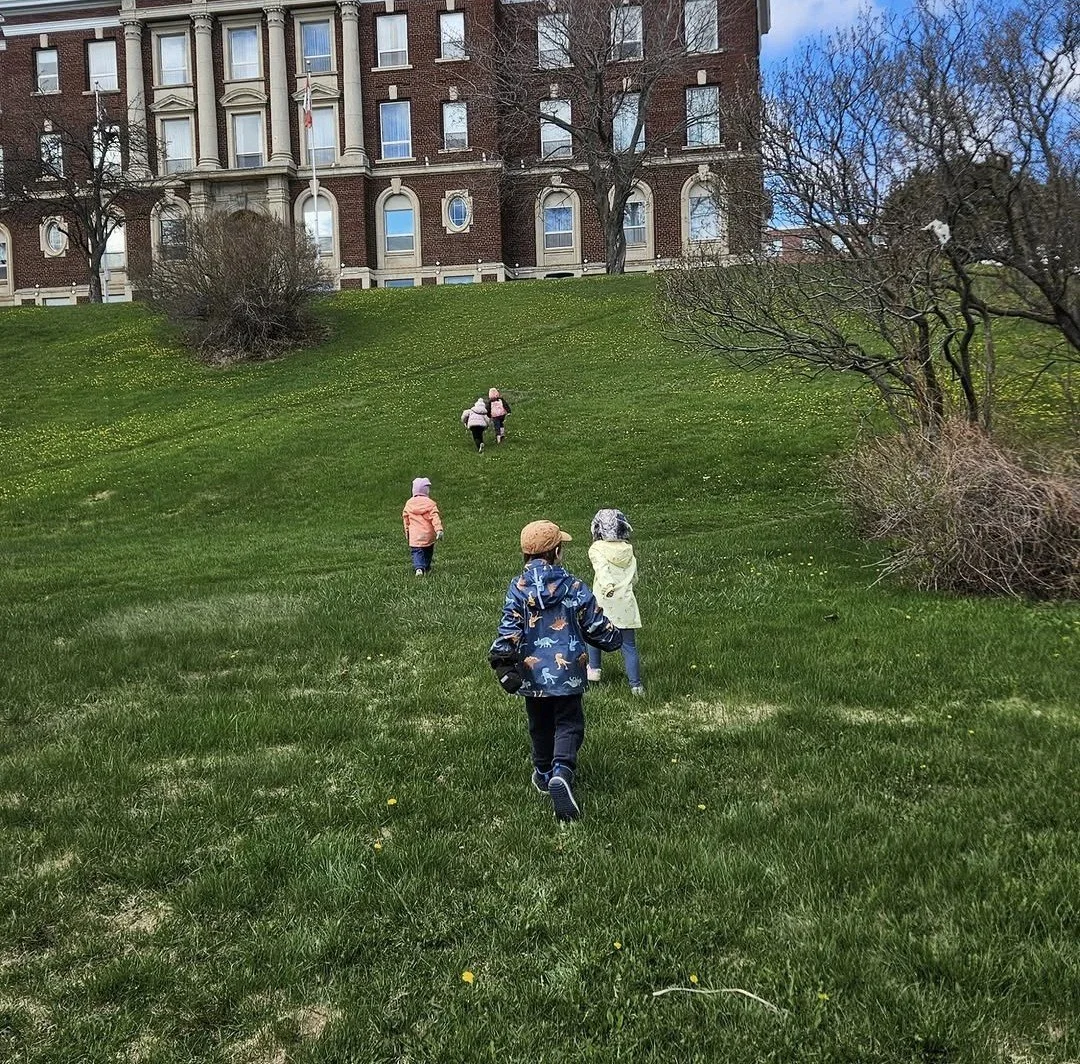
In our school age room the educators give the children lots of space, time and opportunity to encourage physical activity. The school age program spends as much time outdoors as possible around 4 hours a day. The school age room also encourages big body play indoors whether that is with hula hoops, hopscotch, mini trampolines, big body blocks, etc.
-
✺
Cognitive
As children reach kindergarten and beyond they start to understand the world around them better. During these years children start to become aware of the outside world or the world beyond just themselves. During the formative stages we encourage curiosity and give them as much knowledge about the world as possible.
Our school age program is very child-led, if a child shows an interest it is the educators cue to find out anything they possibly can about the subject and share with said child. An example of a child-led subject could be where a child discussed wanting to see a worm outside, how they loved worms or even asking what a worm is. This would be our cue to pull up any knowledge we may have about worms and teach the children who are curious.
-
✺
Speech & Language
School age children are at the age where they are fully conversational, and they tend to want to engage in conversations with the people around them. Children learn most if not all of their language from the adults in their lives first, it is imperative we enunciate words properly and use the correct terms even if the information seems to advance for the child being spoken to.
In our school age room the educators are trained to ensure that they repeat the words that a child might be trying to say. If a child is struggling to say a word, the educator will then repeat the word back to them with the proper enunciation and ask the child to follow their lips or encourage the child to try again. The educators talk to the children as if they are competent and capable, encouraging conversations between educators and children and between the children and their friends.
-
✺
Attention Span
As Children age their attention span begins to grow, in school age we nurture this by challenging the children to focus on one activity at a time, engage in small group times and participate during circle time. It is almost impossible for children to learn or retain any information if they are not able to sit still and pay attention.
In school age it is important to begin to push the limits on maintaining the attention of children. It is important to find the sweet spot of pushing children’s limits of attention and losing them altogether. School age children practice their longer attention spans through engaging activities, enjoying the materials they love, having the autonomy to choose what they may engage in, etc.
-
✺
Problem Solving
Children begin to develop problem solving skills at an even younger age than preschool, at the school age level they develop the confidence to problem solve all on their own. Children who show signs of problem solving must be encouraged to show that others believe they are capable as well. If a child is faced with a problem you can often see the ‘wheels’ or ‘gears’ turning in their brains as they strategically try to figure out a solution. A child may be working on a puzzle with only one resolution and they may end up trying to turn or reconfigure the pieces for a trial and error period.
In our school age program you may notice that the activities provided are trial and error coded, what this means is the children are able to find a solution with little to no guidance. If a bigger problem occurs with a child in the classroom the educators will gently guide the child in the right direction without giving them the exact answer right away. Children need to be given opportunities for trial and error in a safe and positive environment from a young age so that they can thrive as they get older and begin to face challenges that might be presented to them.
-
✺
Early Literacy
For school age children it is developmentally appropriate for them to start honing their love of learning. In school age we build a strong foundation for the educators to begin the introduction for reading. School age children are introduced to letter tracing, sounds, words that begin with each letter and this is the age where any information given to children starts to be retained. School age children often want to reread a short story in which they love, the more they read it the more they begin to understand what the story may be about.
Throughout our classroom you may see letters and letter sounds presented on different textiles, this is to ensure that children receive the multi-sensory experience to understand the learning on a deeper level. The educators are trained to recognize when a child shows interest in reading and foster that interest, whether it is reading aloud, discussing the illustrations, or practicing letter sounds to name a few.
-
✺
Listening & Communication
Listening is when the child can understand what might be said or asked of them in that moment and Communication is when the child is able to express their feelings around what they heard or is asked of them. As school age children explore their autonomy and begin to trust that they are able to express themselves as needed, that is where communication and listening comes in. A big part of children listening at this age is the gained mutual respect for one another, a child must feel heard, respected and understood before they desire to listen.
In our school age classroom listening and communication is demonstrated by the educator getting on the child’s level, giving them their undivided attention and respecting their choices as desired. When a child asserts themselves, it is up to us the educators to show them what it looks like to have their assertions heard, respected, and valued. This is especially important when it comes to consent.